How AI Is Transforming RV Parks in 2026: Smarter Bookings, Dynamic Pricing & Better Guest Experiences
The days of calling an RV park during business hours just to check site availability are fading fast. In 2026, artificial intelligence is quietly—and decisively—reshaping how RV parks operate, how guests book their stays, and how park owners grow their revenue. Whether you are a full-time RVer searching for the smartest parks on your route or an owner trying to modernize your campground, AI is no longer a futuristic concept. It is already working behind the scenes at parks across the country, and the results are hard to ignore. The U.S. RV park industry reached $10.7 billion in value in 2024 and has continued to grow. But with that growth comes rising complexity—labor shortages, higher guest expectations, unpredictable seasons, and the constant pressure to remain competitive. AI is stepping in to address each of those pain points, one smart tool at a time.
AI-Powered Reservations: The End of the Booking Headache
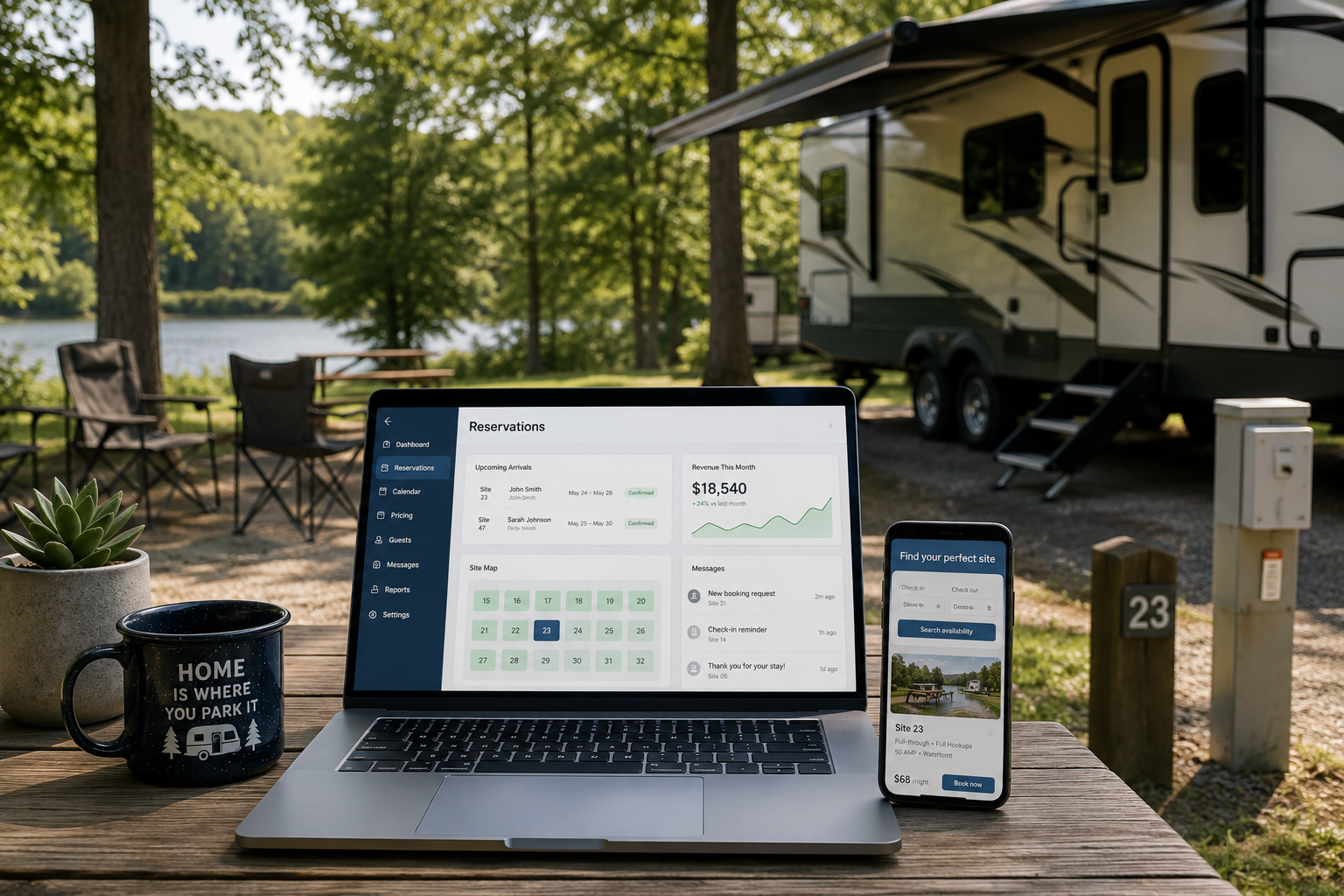
The reservation process is often the very first impression a guest has of your park. Traditionally, it involved back-and-forth phone calls, the risk of double bookings, and site assignments that did not always match a guest's rig size or preference. AI is changing all of that. By analyzing past booking data, guest preferences, and seasonal trends, AI-powered reservation systems can now recommend the most suitable campsites automatically—whether a guest needs a pull-through site near the dog run, a shaded spot for solar panels, or a waterfront location for a family reunion. This speeds up the booking process dramatically and cuts down on last-minute changes and mismatched assignments. Parks that have moved to online booking with AI-assisted site matching have reported a 15 to 25 percent increase in reservations within their first year—largely because bookings now come in at 2 a.m. on a Sunday, not just during office hours. One standout innovation is the AI chatbot. Insider Perks' "Campy" chatbot, for example, allows guests to check real-time site availability, browse site photos, and review pricing—all within a single chat interface, around the clock. Guests can complete a full reservation without ever speaking to a staff member, which is exactly the frictionless experience that modern travelers expect.
Dynamic Pricing: The Hotel Industry's Best-Kept Secret, Now at Your RV Park
Hotels have used dynamic pricing for decades. RV parks are finally catching up, and AI is the engine making it possible. Traditional campground pricing has historically been flat - the same rate on a Tuesday in February as on a Friday in July. That model leaves significant revenue on the table. AI-powered pricing platforms now adjust rates in real time based on demand signals including occupancy pace, day of the week, upcoming local events, seasonal patterns, and even weather forecasts. When a major festival is happening 20 miles away and your park is filling up fast, your rates can reflect that demand automatically. Industry data suggests that parks using AI-driven dynamic pricing see a 20 to 30 percent increase in revenue compared to those sticking with flat-rate models. And importantly, the technology does not replace the park owner's judgment - it enhances it. Owners set the guardrails, and the algorithm works within them.
Smarter Guest Communication Without Adding Staff
One of the biggest operational challenges for RV parks is the staffing crunch. Finding and retaining reliable seasonal staff has become increasingly difficult, and the workload of communicating with guests - booking confirmations, pre-arrival instructions, check-in reminders, post-stay review requests - can consume hours of a manager's day. AI solves this through automated, personalized messaging. Platforms integrated with tools like RoverPass and Zapier now allow park owners to connect AI systems that automatically send booking confirmations the moment a reservation is made, arrival instructions 48 hours before check-in, and follow-up review requests the day after a guest checks out. Once configured, these workflows run indefinitely with zero staff involvement. Text messaging has emerged as the preferred channel for these communications, especially among younger campers. Parks that have moved from email-only communication to multi-channel automated messaging report higher guest satisfaction scores and more online reviews - both of which directly impact future bookings.
Predictive Maintenance: Fixing Problems Before They Become Emergencies
Every RV park owner knows the nightmare scenario: a water line fails during peak summer season, the electrical hookups at Site 42 go down on a holiday weekend, or the dump station breaks just as a line of rigs is waiting to pull out. Reactive maintenance is expensive, disruptive, and damaging to your reputation. AI-powered predictive maintenance changes the equation. By continuously monitoring equipment performance data, these systems can identify patterns that signal an impending failure - a pump running hotter than usual, an electrical connection drawing more current than expected - and alert maintenance staff before anything breaks down. Scheduled preventive maintenance replaces costly emergency repairs, extends the lifespan of infrastructure, and improves long-term budgeting by reducing unplanned costs. AI-monitored security cameras are another component of this smart infrastructure. These systems can detect unusual activity on the property and send real-time alerts to managers' phones, improving safety without requiring around-the-clock staffing.
AI for RV Trip Planning: How Travelers Are Using It Right Now
The AI revolution in RV parks is not limited to the operations side. Travelers themselves are using AI tools to plan their entire trips in ways that were impossible just two years ago. AI trip planning tools now generate complete itineraries in minutes, factoring in a rig's specific height and weight, propane restrictions, low-clearance bridges, steep grades, fuel costs, campground availability, and personal interests. A family wanting a pet-friendly route with hiking stops and a winery or two can get a fully optimized plan in seconds - the kind of itinerary that used to take hours of research across a dozen browser tabs. Travelers using these AI planning systems report cutting trip expenses by $1,000 or more on multi-week journeys through optimized routing, real-time fuel price comparisons, and campground rate scanning. Tools like Roadtrippers Autopilot, updated in late 2025, allow users to input their start and end points, travel dates, rig dimensions, and preferences - and receive a full route complete with bookable campgrounds and points of interest. For RV park owners, this trend has an important implication: if your park is not showing up in AI-generated recommendations, you may be missing a growing segment of bookings. Accurate online listings, up-to-date amenity information, and strong review profiles are becoming more important than ever as AI tools pull from this data to make suggestions.
Real-World Impact: RV Parks Near AI Infrastructure Expansion
There is another, less obvious way that AI is influencing RV park demand. As AI data centers and infrastructure expand into new regions of the United States, construction workers, engineers, and contractors are following - and many of them are living in RVs. RV parks near Abilene, Texas, for example, saw a 20 percent increase in sales and a surge in service requests over the past year as AI infrastructure buildout in the region brought an influx of workers who needed temporary housing. Clear Creek RV, one of the parks in the area, described the growth as unexpected - and entering 2026, demand shows no signs of slowing. This trend is playing out in multiple markets across the country where data centers, energy projects, and tech campuses are under construction. For park owners in these regions, the AI boom is not just something happening inside their management software. It is physically filling their sites.
What AI Still Cannot Do - And Why That Matters
For all of its power, AI works best as a tool that enhances human hospitality, not replaces it. Industry experts consistently emphasize this point. A grumpy front-desk employee can undermine every dollar spent on AI-powered booking systems and smart pricing tools. A beautiful amenity upgrade means nothing if the check-in process is frustrating. Technology should eliminate friction and administrative burden so that staff can focus on the thing that no algorithm can replicate: genuine, personalized hospitality. The parks that are seeing the strongest results from AI adoption are not the ones that have automated everything. They are the ones that have used automation strategically to remove the tasks their teams disliked most—answering the same booking questions over and over, manually updating pricing spreadsheets, and chasing down maintenance requests—so their people can spend more time making guests feel welcome.
Key AI Tools and Technologies Shaping RV Parks in 2026
Several platforms are leading the way in bringing AI capabilities to campground operators:
Campy by Insider Perks—an AI chatbot that handles 24/7 guest inquiries and completes reservations directly within the chat interface. RoverPass + Zapier AI Integration - Connects RV park management software with AI platforms like ChatGPT and Claude to automate guest messaging, reservation reports, and review responses. Firefly Reservations - Offers AI-powered dynamic pricing recommendations and automated communication workflows for campground operators. Roadtrippers Autopilot - A trip planning AI that generates RV-safe itineraries based on rig specifications, travel dates, and personal preferences. QCI RV by Quick Custom Intelligence - A new platform connecting RV park operations with casino loyalty programs through AI-driven guest data analysis.
The Bottom Line for RV Park Owners and Travelers Alike
AI is not coming to the RV park industry. It is already here, and the gap between parks that have adopted it and those that have not is widening every season. For park owners, the practical starting point is identifying your biggest pain point - whether that is lost bookings from lack of online reservations, revenue left on the table with flat pricing, or staff time consumed by repetitive guest communication - and finding the AI tool that addresses it directly. The technology is more accessible and affordable than it has ever been. For travelers, the message is simpler: the best RV parks in 2026 are smarter, more personalized, and easier to book than ever before. AI is working in the background to make sure the right site is waiting for you when you pull in.
Experience the Future of RV Travel at Lubbock RV Park
All of this innovation points to one thing: the best RV parks in 2026 aren't just places to park your rig—they're fully connected, guest-first experiences designed to make your stay seamless from the moment you book to the minute you pull out. At Lubbock RV Park, we're committed to giving every guest exactly that. Whether you're passing through West Texas, settling in for an extended stay, or relocating for work in the region, we've built an experience that takes the hassle out of RV living. ✅ Easy online reservations — book anytime, day or night ✅ Full hookup sites designed for rigs of all sizes ✅ A welcoming community right in the heart of Lubbock, TX Ready to see why travelers keep coming back? 👉 Book Your Site Today at Lubbock RV Park and experience a smarter, more comfortable stay in West Texas.
Frequently Asked Questions
Do RV parks use AI? Yes. In 2026, a growing number of RV parks and campgrounds across the United States will use AI-powered tools for reservations, dynamic pricing, guest communication, and facility maintenance.
How does AI help RV park owners increase revenue? AI-powered dynamic pricing adjusts rates based on real-time demand signals, helping parks capture more revenue during peak periods. Industry benchmarks suggest parks using AI report a 20 to 30 percent revenue increase compared to flat-rate models.
Can AI plan an RV trip for me? Yes. Tools like Roadtrippers Autopilot and other AI trip planners can generate complete RV-safe itineraries factoring in your rig's size, fuel costs, campground availability, and personal interests - often in just a few minutes.
Is AI replacing campground staff? No. AI is designed to reduce the burden of repetitive administrative tasks so that staff can focus on delivering better guest experiences. The most successful AI adopters use technology to handle logistics while their people handle hospitality.
What is the best AI tool for RV park management? It depends on your biggest pain point. Campy by Insider Perks is strong for 24/7 guest communication and bookings. Firefly Reservations is well-regarded for dynamic pricing. RoverPass with Zapier offers flexible AI automation for guest messaging and operations.